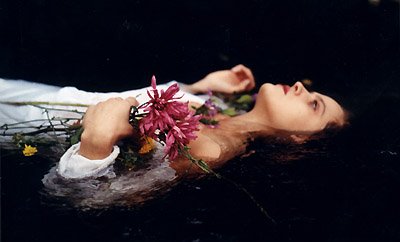
As we are all gathered year today, we honor and remember the beloved Ophelia. It's such a shame that she died so young, and in an eccentric mental state. We grief in disbelief to not only the cause of her death, but also to the events leading up to it. Everyone in attendance can remember a time when this beautiful, lively, young woman treated everyone with respect. Aside from being respectful, Ophelia was a joy to be around because she was very friendly and she had a wonderful personality. I can't fully comprehend how or why Ophelia went mad to the extent of possibly killing herself, but the fact that people are questioning whether it's appropriate to have a Christian burial for her is beyond me. I believe that Ophelia deserves this Christian burial, regardless of how she lived her last few days on this planet.
Ophelia was the type of person that anyone could get along with, and her relationship with Hamlet was pretty much well known throughout Denmark. However, once Hamlet went insane, he abruptly ended their relationship, and this probably caused Ophelia's mental state to deteriorate. Then, Hamlet ruthlessly killed her father Polonius, and the King didn't even give him a proper burial. Because of this, Ophelia's loopy behavior was displayed when she began to sing songs about her father's death. I watched in shock as my friend was transformed into a completely different person, one that is mentally ill. And as I began gathering information about the origins of Ophelia's deranged state, I concluded that Hamlet was the cause of it. He's the man that went insane, that broke her heart, and the man that murdered her father.
Just before Ophelia drowned, Gertrude said that she was still singing bits of old hymns as her clothes absorbed the water and submerged her into the willow. Even though her mind wasn't in the right place, I find it very hard to believe that Ophelia's last words were a song, instead of cry for help. How could she not realize that she was drowning? If Ophelia fell into the water and drowned because of her heavy dress, then why are some many people accusing her of committing suicide? Who's to say that Ophelia really did call for help, Gertrude was the only one that witnessed it all. Whatever the reason is, I'm just glad Ophelia will be in a better place. May Ophelia and Polonius rest in peace.
Sunday, May 17, 2015
Saturday, May 9, 2015
(Kibwe's) English III Blog: Hamlet's Dilemma
After discovering the truth behind his father's death, Hamlet thinks of a plan to avenge his death. Hamlet pretends to be crazy so that he may use that as an excuse for the malicious things he plans to do later on in the play. This may seem like a clever plan, yet Hamlet stalls when he has the chance to kill Claudius. In Act 3/Scene 3, Hamlet refrains from killing a very vulnerable Claudius. If Hamlet killed Claudius in his time of prayer, Claudius would've been sent to Heaven because he was confessing his sins. Not only does Hamlet want to kill Claudius, he wants him to suffer in the afterlife like his father, who died unprepared for Heaven since he didn't get to confess his sins. Some may say that Hamlet is delaying his plan by not killing Claudius when he gets the chance, but I think Hamlet knows what he's doing and is making the right choice. Sending Claudius to Heaven will be much worse than keeping him alive, plus that would render his plan a failure.
What Hamlet plans to do is kill Claudius when he is in the act of sin. By doing that, Hamlet will have the pleasure of ridding Claudius from the world, sending him to Hell, as well as removing him from the throne. Otherwise, Hamlet will be the one sent to Hell when he's executed for killing the King, while in prayer or if he decides to commit suicide after he murders Claudius. Even though King Hamlet's spirit will forever remain in Purgatory, if everything goes as planned, Claudius will be condemned by God to suffer eternal punishment in Hell. Also, because many people already believe that Hamlet is actually crazy, insanity can be used as an explanation for his actions. As ridiculous as it may seem, murderers in the past, and in the present, have pleaded insanity and successfully avoided life imprisonment and execution. Hamlet could very well get away with killing Claudius, we just have to be patient because he will do it at the right place and at the right time.
Tuesday, May 5, 2015
English III Blog: To Be or Not To Be (Kibwe)
Hamlet's famous "To be or Not to be" soliloquy has been reacted and brought to the big screen numerous times decades. In Laurence Oliver's film adaption of Hamlet, he both directs and acts out his version of the soliloquy. Since this version of Hamlet is much older, it was filmed in black and white. It starts off with Hamlet looking off into the ocean, then he pulls out his dagger because he's contemplating suicide. After saying a few sentences, the lines shift from being vocalized to being mentally spoken, then it continues until the lines are verbally spoken again. I found quite interesting how Oliver chose to use this transition between word and thought because for the most part, this soliloquy was basically a mental conversation between Hamlet and himself in the real play. Also the when the camera zooms into Hamlet's face, the music intensifies as he reverts back to speech. For the rest of this scene, there really isn't any music playing and the only background noise you hear is the ocean. However, it seemed like Oliver delivered his lines with little to no emotion and this scene had a tedious ambience.
Franco Zeffirelli's version starts off with Hamlet walking into the catacombs of the Elsinore castle. I immediately felt a sense of irony because a speech about death was going to be delivered in a tomb for the deceased. At this point I realized that Zeffirelli's version as a whole seemed to be the most realistic movie adaption of Hamlet. Since this took place in the catacombs during the day, the only light source available were sparse sun rays that shined through openings in the ceiling. Early in his soliloquy, Hamlet rested his head upon a tomb before briefly looking up into the sky. Hamlet wanted to die and he must've felt that being in a tomb was the only way to avoid the hardships he faced in life. When Hamlet looked up into the sky, it seemed as if he wanted God to hear his feelings about taking one's life. Also, Mel Gibson delivered his lines with a lot of emotion and you were able to sympathize with his problems because you could tell how much he yarned for an end to his pain.
Kenneth Branagh starts off his soliloquy very slowly as he stares at himself through a mirror in an empty lounge room. As Hamlet moves toward the mirror you could her a faint instrument playing in the background. I think Branagh wanted to emphasize the fact that Hamlet was having a conversation with himself, so he chose to have the soliloquy take place in front of a mirror. When Hamlet pulled out his dagger and spoke to his reflection in the mirror, it seemed as if he was taunting himself to commit suicide. Other than these elements and the extravagant colors of the lounge room, this version of the soliloquy wasn't that special. Branagh's acting was monotone because he didn't show that much
emotion.
The last film adaption of the "To be or Not to be" soliloquy I saw was the Almereyda version. This is the modernized version of Hamlet and it took place in a Blockbuster store. It starts off as a thought in Hamlet's mind before it's switched over to speech, similar to Laurence Oliver's Hamlet. Hamlet then starts to walk down the action movie section of the DVD store, most likely due to the fact that the main concept of this soliloquy is suicide. Hamlet was speculating suicide because he felt that the only action he should take to resolve his problems was to kill himself. At the end of the section in which he was walking was a TV playing "The Crow". In my opinion, I think the director used this particular movie to display Hell, the afterlife Hamlet would encounter if he did kill himself. However, I just can't take the use of Shakespearean language in the modern world serious. Even though certain elements of this version of Hamlet were clever and unique, I found it quite comical about the way Almereyda constructed this movie.
Monday, April 27, 2015
English III (Kibwe): The Ghost Scene
After watching all three film adaptations of the ghost scene in Hamlet, I made three different reflections on each one. Some versions did better than others when it pertained to certain aspects of the story. The Zeffirelli version was more realistic in terms of the lighting and the overall atmosphere that would have existed during that time period. The ghost scene took place on top of a castle and very little lighting was used, so it was very dark and somewhat hard to distinguish the setting and the characters. There wasn't much noise or music and you could tell that the main focus was on the conversation between Hamlet and his ghost dad. You could also see the terror and confusion in Hamlet's eyes as his father informs him. After the ghost revealed to Hamlet the complete story of his demise, Hamlet begins to act in a very anxious manner as he watches his mother flirt with Claudius.
The Branagh version of the ghost seen begins with very fast spoken dialogue as a panicky Hamlet runs through a spooky forest. Branagh emphasizes the spookiness of the forest by using blue light, smoke, and eerie music. You actually see the ghost in this version, plus he's wearing the suit of armor you read about in the play. Branagh uses flashbacks as the ghost is speaking so the audience can visually see how the Hamlet senior died. Because of these flashbacks, you can make clear assumptions as to why Claudius murdered his brother and you can speculate Gertrude's involvement. After the ghost disappears, you can tell how determined Hamlet became to avenge his father.
Almereyda's version of Hamlet is modernized and the confrontation between Hamlet and his father's spirit takes place in his apartment. It was pretty strange how casual this scene started because the ghost just leisurely walks into his son's apartment like a visiting relative. The ghost intensifies the scene by getting into Hamlet's face and embracing his head as he's informs him of his demise. All throughout the scene, you could see how intimidated Hamlet was of his dead father. At the end, the ghost actually hugs Hamlet before disappearing, which probably means that he wanted his son to requite his honor.
Subscribe to:
Posts (Atom)
